By now, you should have become use to reading hiragana and katakana; and learning new words relating to your own interests and needs. I think now is the time to learn about the more complex system of reading and writing in Japanese: kanji.
The issue with hiragana and katakana is that there are a number or ways to write the same word but with different meanings; this can make it difficult to know which meaning is being used.
にわには
There are two chickens in the garden
By using kanji, we focus on meaning rather than sound. However, this leads to another problem. If we focus on meaning instead of sound, how do we read the kanji? Most kanji have multiple readings and this tells us what sounds can be used.
庭には
There are two chickens in the garden
When we talk about using or learning the kanji, we are referring to understanding the meanings, studying all the readings, knowing the stroke order and learning how to write them.
This is similar to the Roman alphabet in English. In nursery and primary school, you will have learnt: how to pronounce each letter, groups of letters and whole words; how to write them and use the correct "stroke order"; how to combine them to form words with meanings; and at the more advance level, read multiple words as singular groups, known as chunking for reading 1,500+ words per minute.
What is Kanji?
Kanji is a writing system which has its roots in China and was adopted by Japan during the 5th or 6th century. Before this period, Japan had no official writing system but it did have a spoken language. When kanji was first introduced, native Japanese words were associated to these Chinese characters. By the 8th century, kanji became fully integrated into the Japanese language and an essential skill for learners.
Many kanji kept their original pronunciations but with addition to native Japanese meanings and readings. This makes learning kanji more challenging as there are few ways of pronouncing the same words and kanji: kun'yomi (訓読み), on'yomi (音読み) and tokubetsu'yomi (特別読み).
For example, 人 (person) is pronounced "hito" and 口 (mouth) is pronounced as "kuchi" using kun'yomi (Japanese reading) but together, 人口 (population) is read as "jinkou" using the on'yomi (Chinese reading). For the most part, you will only need to think about 訓読み (Japanese readings) and 音読み (Chinese readings). However, there are a few very common words that still use 特別読み (Special readings).
While kanji can be used for all kinds of words, Japanese cannot be written using only kanji alone. We still need the use of the other two writing systems we covered before: ひらがな and カタカナ; these are for grammatical purposes, foreign load words and native Japanese words that do not have related kanji.
Learning ひらがな and カタカナ alone will not help you with real everyday Japanese reading and writing. Kanji is used everywhere, from written communications (emails, letters, newspapers, social media etc.), signs, names and places and so on.
There are thousands of kanji characters but luckily, only about 2,136 of these are considered necessary. That is still quite a lot considering there are multiple ways of pronouncing them and to express different meanings. If that was not enough, many kanji also share the same pronunciation but have different meanings so learning the pitch accent too is necessary if you want to sound like a native.
On a positive note, you will gain a deeper understanding of Japanese culture and even pick up on subtle nuances in meaning lost through history. You will also not have to deal with inaccurate translations, untranslatable words and Western woke localisations.
Learning the Kanji
The first thing to understand is that you cannot technically learn kanji; this is because kanji are not words, they are a group of concepts which do not always have one fixed meaning (reading, meaning, stroke order, radicals, compounds and so on). For example, 生 can mean life, birth, raw, student, inexperienced and so on, depending on the context; and its reading may also change.
Instead of trying to memorise individual kanji characters in isolation, focus on learning words that contain them. This way, you learn kanji naturally and in a more meaningful context. For example, instead of just learning the word 水 (water), try to also learn 水曜日 (Wednesday) 水道 (water supply), 海水 (seawater).
You will find that most kanji are actually made up of smaller parts called radicals; learning these will speed up your recognition of kanji and improve your memory. Some kanji also have a phonetic component that will hint to how the word is pronounced, though not all follow this since they may have several readings.
For example, if you already know the following kanji characters: 言 (word), 口 (mouth) and 五 (five); you can form 語 (language; word). Here, 言 (word) and 口 (mouth) represents "spoken words" (word + mouth) and 語 is pronounced with 五 (ご). Altogether we get: 日本語 (nihongo) "Japanese language"; 英語 (eigo) "English language"; 語順 (gojun) "Word order"; and 敬語 (keigo) "Honorific language".
While learning the kanji, expose yourself to real Japanese content rather than artificial examples used in basic textbooks or classrooms; these might include TV, anime, films, newspapers, magazines, games, music and so on. This way, you will more likely learn the more common kanji rather than the outdated and uncommon ones.
When it comes to remembering the kanji, try to form mnemonics rather than brute force repetition; by this, we mean stories, associations and visual connections. Let us use 休 (to rest) as an example: imagine there is a person (亻) resting against a tree (木).
Where to start?
There is no right or wrong way to start learning the kanji, regardless what other people may argue. What works for one person, does not necessarily work for another.
If you are self-studying and you learn best through theory or you are an analytical person, there are many textbooks that can help. While some people do appeal to ignorance and hate textbooks by making hasty generalisations that all textbooks are unnatural and bad simply because of a few poorly written ones they have seen, not all textbooks are entirely useless.
People with a pragmatic personality learn best when they have hands-on experience; this means that they may find textbooks too boring but outperform when they are engaged in practical settings like: talking to people; playing video games; or watching anime with Japanese subtitles.
Unfortunately, we cannot list every method here so we will provide a suggestion that can act as a foundation that you could develop as you learn more of the kanji:
- Learn the most common radicals first to recognise kanji components.
- Focus on meanings first, without worrying about how to pronounce them just yet.
- Learn readings through vocabulary, not as random kun'yomi and on'yomi lists.
- Immerse yourself in real life Japanese (reading, listening, subtitles etc.)
- Do not worry about stroke order unless you actually plan to write.
1.1 Radicals (部首)
Radicals form the components of complex kanji; for example, the kanji 語 for "language" is made up of three parts: 言 on the left side, 五 in the top right and 口 in the bottom right.
Radicals are the building blocks (foundation) of kanji and they make recognising patterns and guessing meanings of new kanji much easier. For example: 木 (tree), 林 (woods) and 森 (forest) all contain the radical 木; notice how the meanings are also related to each other.
However, it should be noted that you only need to learn the most common radicals. There are about 214 radicals and it is not necessary to try to remember all of them. Just learn the ones you come across first and those that appear very often.
1.2 Kanji Compounds (熟語)
Where radicals form the smaller parts of a kanji, compounds refer to a group of kanji together; kind of like how in English we have a group of syllables to form a word (i.e: alphabet = al + pha + bet) or parts of words connected (e.i: octagon = octa [eight] + gon [angle] = "eight-angle shape"). When multiple kanji are grouped like this, they create new meanings and concepts.
Rather than learn each kanji as isolated words, understand the concept of each kanji and how they work together as a whole and within context.
For example, the kanji 日 means "sun" and 本 means "origin"; altogether we get 日本 (nippon) meaning "origin of the sun" or "land of the rising sun" which we know today as "Japan". Now, if we add 語 (language) to the end of 日本 we get 日本語 (nihongo) which means "Japanese language". There are plenty more: 日本海 (Sea of Japan); 日本人 (Japanese person); 日本車 (Japanese car) etc.
Now, instead of trying to remember as many kanji compounds as possible all at once, learn them through context like in sentences, articles or books instead of flashcards; create your own example sentences; and try reading news articles, blogs or social media posts to see how they are used naturally. For example:
-
日本語
しゃべれますか 日本語 (Japan + Words)
Can you speak Japanese?
-
試験に失敗した
失敗 (Fault + Failure)
I failed the exam
-
こんな
高価 そうな 物・・・ 受け 取れないよ 高価 (High + Price)
Something that looks this expensive... I cannot take it.
While it is often possible to guess the meaning of a kanji compound by knowing the meaning of the individual kanji, not all kanji compounds are so transparent so you may need do some repetitive memorisation. Many kanji compounds have concepts that are too complex to fit any specific meaning.
It is important to remember that native Japanese speakers generally do not think about the meanings of individual kanji; they already know words before ever seeing the kanji for the first time and when they do, they just see it as a whole.
電車 is already understood to mean "train", without needing to know that it is an 電 (electric) 車 (vehicle). A young Japanese child will know that でんしゃ means "train" and that the word for this is 電車 but they will not learn 車 until Year 1 at school and then 電 in Year 2 so it is unlikely that they will necessarily know the meanings of the individual kanji.
This is similar to English were you already know what a "dinosaur" is without needing to know the Greek words "deinos" (fearfully-great; awe; reverence; power) and "sauros" (lizard; reptile). Most English speakers will probably not even know what "deinos" or "sauros" mean or that the word "dinosaur" comes from the definition of a "fearfully-great lizard".
Another example is "hydrogen" which is taken from the Greek words "hydro" (water) and "genes" (maker; generator; former) to mean "water maker" because hydrogen and oxygen combined produce water. We can also take "Lithium" and find the Greek words "lithos" (stone) and the Latin suffix "~ium" that forms abstract nouns, in this case "element", to mean "stone element".
Notice that you may have used these English words (dinosaur; hydrogen; lithium etc.) without ever thinking about why they are spelt the way they are. You know what they are but do not know why. This is the same when learning Kanji compounds; 電車 means "train", there is very little need to know it is composed of the words "electric" and "vehicle". In fact, some trains are not electric powered.
For the purpose of learning, whenever you come across new kanji compounds, try to check and see if you already know another word using one of its kanji. If not, you only need to know the meaning as a whole rather than dissecting each part.
For example, 心 (heart; mind) appears in multiple kanji compounds, all of which relate to emotions or mental states: 安心 (peace of mind); 心配 (worry); 決心 (determination); and 感心 (admiration). This is similar to English where "oct" (eight) can be used to make words like: octave (eight note interval), octopus (eight sucker-bearing arms), octagon (eight angles), octogenarian (80 to 89 years old) and so on.
As mentioned earlier, not all kanji compounds are so transparent; meanings are not always obvious just from the kanji alone. Japanese, just as in English, may use idiomatic expressions or semantic shifts. For example, the kanji compound 大人 (adult) is made of "big" and "person" but the reading is irregular. Similarly, October is no longer the eighth month.
The best approach here is a Japanese-First method; before learning radicals, kanji and compounds, learn Japanese vocabulary first, just like a native would. By Japanese-First, we mean no English is allowed.
2.1 Meanings (It's a race, I'm in a hurry!)
Learn the meanings of kanji first, without worrying about how to pronounce them just yet; this is about recognition and memory, not: writing, stroke order or readings.
Generally, the best and most efficient way to do this is to stop using English and rely solely on Japanese. This way, you can learn kanji naturally and gain a much deeper understanding of the language, history and culture without having to overcomplicate the language with the incompatible use of English.
Unfortunately, this is not great for anyone who has not learnt a lot of Japanese words already; this can become overwhelming and frustrating for beginners.
Many kanji represents abstract ideas that are far too difficult to define with other Japanese words you have not yet learnt. You might find yourself endlessly looking up every new kanji definition, their readings and pronunciations. Native Japanese speakers learn kanji through exposure and context, not by reading kanji definitions. Without English as a reference, it can be confusing and inefficient.
Therefore, it depends on your level of Japanese:
If you are already at an intermediate or advanced level then using only Japanese will be more meaningful and efficient. It enables you to think in Japanese instead of translating everything, to understand the different nuances each word has and to improve your long-term memory by linking the kanji to Japanese contexts rather than English. You can start to do this as you learn more kanji meanings.
For a beginner, it would require extra effort to understand even basic concepts which can be very frustrating and inefficient if you do not already have enough Japanese vocabulary. By relying on only Japanese, it will slow your progress down compared to using English as a reference.
Here, your attempt is to learn all the kanji within six months (about ten kanji per day). Just understand that it takes over ten years for native Japanese speakers to learn kanji and that does not cover all of them nor will most natives be able to recall all of them. Many of which end up written in hiragana instead.
Avoid learning all readings and meanings at once; focus on just the meanings in English and then when you are confident enough, try to guess meanings from context before checking translations. Once you understand the meanings to most kanji, try reading news articles, books and novels without relying on English and look up words in a Japanese dictionary if necessary.
The only issue with this method is that you will find yourself revisiting the same kanji multiple times: first to recognise it, then to learn its Japanese usage and finally to master its readings. It is like building a bridge from English to Japanese, only to then dismantle it later when you want to think directly in Japanese. This only reinforces the bad habit of translating everything through English in your head.
Ultimately, kanji should be understood through only Japanese itself so make the switch slowly and when it becomes natural to you.
2.2 Meanings (Quality vs Quantity)
Now, what if you do not care about learning as many kanji as possible in the least amount of time as if you are competing for a race? As mentioned before, kanji should be understood through only Japanese itself. Using English is very inefficient and only increases your reliance on English.
Learning as many kanji as possible in a short amount of time might be great if you absolutely must know them sooner like getting a job in Japan in the next few months or passing an exam but the best approach is to associate kanji with actual Japanese words from the start, rather than relying on English. This aligns with how native Japanese speakers learn kanji, by connecting them to words they already know.
English words fail to capture the full nuances of a kanji. While 木 = "tree" is not necessarily wrong, "tree" in English just means a single living plant while 木 has a broader concept to wood and nature. It is also the same kanji used for days of the week: "Thursday" = 木曜日 (mokuyoubi). English words often oversimplify these nuances, leaving you to patch up the gaps in knowledge later.
When kanji are tied to real Japanese words from the start, you will pick up readings more naturally instead of having to memorising them separately. For example: 木 (ki), 林 (hayashi) and 森 (mori). Instead of learning a vague "kanji meaning" in English, you are learning actual words you can use in real conversations. Remember to look up the pitch accent too.
When you constantly rely on English, you will tend to translate everything in your head but if you learn words directly in Japanese, it becomes much easier to think in Japanese without any awkward or inaccurate translations. For example: Instead of thinking 木 = "tree", you should associate 木 (ki) with the object itself (especially if you can do so visually).
Just remember that not all kanji are words, do not try to remember all kanji in isolation (single characters); instead, learn them in context such as compounds and in sentences.
This method will feel extremely slow to start with compared to relying on English and even take you a few years but it has the advantage of taking you much closer to native Japanese fluency with a deeper and richer understanding than what most popular textbooks, apps, videos or teachers will teach.
3 Readings with Context
Kanji in Japanese can take on one or more readings with these being grouped into three kinds: kun'yomi (訓読み), on'yomi (音読み) and tokubetsu'yomi (特別読み). The most common of these are the kun'yomi and on'yomi so there is no need to worry about tokubetsu'yomi too much for now.
While Japan did not initially have a written language, it did have a spoken one and when kanji (Chinese characters) were first introduced, native Japanese words were associated with them. For example, when the Chinese character 川 (sen) for "river" entered Japan, it was given the Japanese word for river which is pronounced as "kawa". This is known as kun'yomi, the Japanese reading of kanji.
Some words were taken directly from Chinese such as 人口 (jinkou) meaning "population" so it uses the same Chinese reading which is known as on'yomi; this can only be used as a compound, not as separate kanji. The Chinese reading 人 (jin) by itself is not a word in Japanese but 人 (hito) is since "hito" is the native Japanese word for "person" so it uses kun'yomi instead.
人 (person)
- kun'yomi: ひと、 -り、 -と (hito; -ri; -to)
- on'yomi: ジン、 ニン (jin; nin)
口 (mouth)
- kun'yomi: くち (kuchi)
- on'yomi: コウ、 ク (kou; ku)
This can be challenging to know when to use one reading over the other, especially if you come across a kanji or group of kanji you have never seen before and do not know which reading it might use but there is an easy guide that we can use to figure it out.
-
If the kanji is all by itself or followed by hiragana (okurigana) then most of the time, it will use the kun'yomi reading.
- 父 = chichi (my father)
- 子 = ko (child)
- 海 = umi (sea)
- 水 = mizu (water)
- 食べる = taberu (to eat)
- 行く = iku (to go)
-
If a Kanji is followed or preceded by another Kanji then it will most likely be on'yomi. Both Kanji are generally read in on'yomi (see how the readings from the kanji above now change).
- 父子 = fushi (father and child)
- 海水 = kaisui (seawater)
- 行進 = koushin (to travel)
-
Some kanji have special readings that are neither kun'yomi or on'yomi known as tokubetsu'yomi. These kanji can only be read together, not separately. You will just have to remember these.
- お父さん = otousan (father)
- 行方 = yukue (whereabouts)
- 行灯 = andon (Traditional lantern)
This is similar to the rule in English spelling where you have "I before E, except after C" and in much the same way, both of these rules are not always accurate. For example, "veil; sufficient; their" do not follow the I before E rule in English; and in Japanese, some kanji compounds actually use kun'yomi.
You will find that kun'yomi is more common with proper nouns but watch out since many names and places still use the on'yomi reading. Even many kanji followed or preceded by katakana will use on'yomi. It is worth to check a dictionary if you are not entirely sure.
When you come across reading charts or some guides, ひらがな will be used for the Japanese readings (kun'yomi) and カタカナ for Chinese readings (on'yomi).
4.1 Kanji in Vocabulary
Rather than learning kanji in isolation, try associating them with Japanese vocabulary from the start. By isolation, we mean instead of just reading 電 (electricity) and later 車 (car) separately, learn words like デンシャ (train) and link this to the kanji compound 電車 directly without thinking about which reading is used or what the radicals or individual kanji represent unless it helps with memory.
For example, 電 holds the concept of "electricity" but it cannot be used in isolation since there are no native Japanese vocabulary associated with it, therefore, if you wanted to say "electricity", you would need to use the kanji compound 電気 instead; and because of this, it will use the on'yomi reading デンキ.
Also, learning kanji in isolation can introduce confusion when associated with English words, for example, both 速 (haya) and 早 (haya) are pronounced the same and have the concept of "speed; fast; early" but they are used in different context.
Therefore, instead of just defining 速 and 早 as "fast" and "early" (which is very vague), you can learn them through actual words. Notice how the English changes too when used in compounds:
- 速い (hayai) = fast (speed-related)
- 早い (hayai) = early (time-related)
- 早速 (sassoku) = immediately
- 速達 (sokutatsu) = express delivery
- 早口 (hayakuchi) = fast-talking
- 早口言葉 (hayakuchikotoba) = Tongue-twister
Also, replacing a word like 早口 (fast-talking) with 速口 would be unnatural so seeing 速 and 早 used in vocabulary like the above examples make it obvious when to use each and you will naturally learn the readings at the same time without forcing yourself to memorise random kun'yomi and on'yomi lists.
This is similar to English when we think about how Latin and Greek words are used in the English language such as "aqua" (Latin) and "hydro" (Greek) which both refer to the concept of "water". The kanji for "water" is 水 with the kun'yomi being "mizu" and the on'yomi "sui".
Knowing that 水 holds the concept of water, imagine that the kun'yomi is read as "water" and the on'yomi as "aqua" or "hydro"; can you guess which would be the correct reading in the following list?
- sea水
- 水rium
- 水electricity
Hopefully, you already knew what the English words are for these; you did not really need to know which reading (water; aqua; hydro) to use, you used your knowledge of existing vocabulary (schema) to deduce which words were the correct ones. Of course, if you had thought of words like "seahydro", "waterrium" or "aqua-electricity", it might have sounded very strange.
Many kanji have lots of different readings and trying to learn all the kun'yomi, on'yumi and tokubetsu'yomi lists of every kanji is very inefficient and impractical.
It may be best to begin with at least 100 or more common words that use single kanji characters like those from the N5 JLPT or 常用漢字 (Jouyou Kanji) as a foundation; this is not meant to take years but it acts as a pathway into learning the more complex kanji compounds, their meanings, readings and stroke order.
Since you are learning the kanji's shape, meaning and reading all in one go with real Japanese usage, there is no need to revisit it later to unnecessarily convert it from English to Japanese. This is because you are already thinking in Japanese from the very beginning, avoiding the bad habit of translating everything through English in your head.
On an important note, instead of just trying to memorise long lists of kanji compounds and vocabulary, learn them through real Japanese sentences to understand how they are actually used in context. At first, this method can feel very difficult but it is not about rushing to memorise 2,000+ kanji.
4.2 Kanji in Context
The more you see kanji used in natural sentences, the easier it will be to remember them. Learning new words and kanji may be useful but without knowing how they are used in context makes this process more difficult and longer to master.
While English offers a quick and accessible way of understanding the ideas of kanji and other aspects of Japanese, it also introduces a cognitive bias known as the illusion of fluency. When study material is easy to understand and presented in a clear way, it makes us think that we actually understand everything and have learnt a lot; this then later turns out, we do not know much about the subject and cannot recall it.
The goal here is to phase out English dependency as soon as possible, using it only as a sort of crutch when it is absolutely necessary to grasp a brief understanding. There is no need for endless writing drills, flashcards or memorisation of outdated or rare kanji.
The best way to reinforce kanji memorisation is through real life exposure; by this, we mean learn by watching YouTube videos uploaded by Japanese speakers (with Japanese subtitles if possible), watch anime with Japanese subtitles, play video games in only Japanese, read manga and light novels, listen to podcasts, read or listen to the Japanese news, read social media posts and comments in Japanese etc.
For example, take the following screen shot of a video game announcing the date and time. This is useful for seeing how the kanji relating to day, date and time is used in context, rather than the artificial examples presented in books, apps or the classroom:
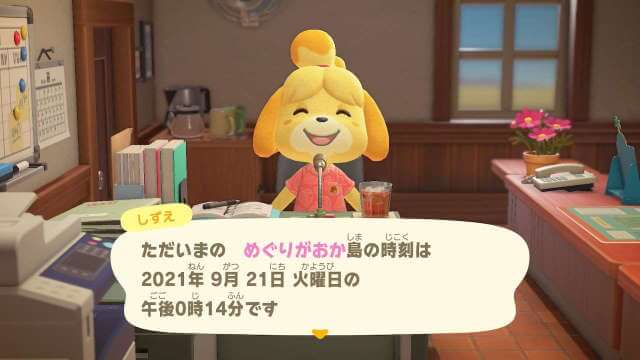
ただいまの
2021年
午後
As for the current time on Megurigaoka island right now, it is 12:14 PM on Tuesday, 21st September 2021.
Try looking up any kanji or kanji compounds you do not know with a dictionary. Do not try to learn every kanji you come across all at once. Just try to recall the ones you are practicing and see if you can identify them without looking them up.
※ Please note that many anime, manga, light novels, games and such include decorative or personalised speech patterns or writing styles that are not used in normal everyday Japanese and may be very unnatural. They may also use very rare words and kanji that you will almost never hear or see being used outside of these works.
5. Stroke Order (書き順)
If you want to start writing kanji, it is best to begin with knowing the stroke order first.
Many people may claim that knowing stoke order or simply knowing how to write kanji is not important since we now live in an age where we can just type on a keyboard. many PC's, tablets and phones even have a feature that enables automatic suggestions so you do not need to type out the whole kanji compound. However, this does have its faults regarding learning.
While the use of technology has reduced the need for handwriting, learning how to write instead of typing on a keyboard is still important for many reasons. Studies show that handwriting activates different parts of the brain, leading to better memorisation, cognition and deeper understanding; while those who type are able to write more words, they experience decreased understanding and loss of memory over time.
If you just type kanji, you might forget it easily but if you write it by hand, you are more likely to think about recalling the kanji; and the motion of writing helps to fix it in memory. Also, if you do not know the correct stroke order, recognition software and digital dictionaries might not understand your input. Writing kanji also helps you notice subtle differences between similar characters, for example: 見 and 貝.
Handwriting does have its disadvantages, though; it takes too long to write, your hand may get tired quickly and the reliance on technology means you find yourself typing far more words than handwriting making it feel less relevant.
Many online dictionaries such as japandict.com, jisho.org or jpdb.io will show you the stroke order of any kanji you are not sure about, if you are interested.
Also, there is an easy guide that we can use to guess the stroke order but there are some kanji that do not follow these points so it is still worth checking a dictionary just in case. In the following guide, the coloured dot represents where to start writing:
-
Horizontal strokes are written from left to right, starting from the topmost stroke:
-
Vertical strokes are written from top to bottom, starting from the leftmost stroke:
-
When there are intersecting horizontal and vertical strokes, the horizontal stroke is usually written first (though not always). Here, the top horizontal strokes are written first then the vertical stroke (notice that the first stroke in this kanji is an exception to step 1):
When a horizontal stroke is at the very bottom, this is written last.
-
When there are diagonal strokes, the leftmost stroke is written before the right one:
-
When there is a square, the left vertical stroke is written first then the right corner (starting left to right); finally, the bottom horizontal stroke:
When there are strokes within a square, these are written before the bottom horizontal stroke:
When there are intersecting horizontal and vertical strokes within a square, the vertical stroke is usually written first (this is an exception to step 3):
-
When a kanji is somewhat symmetrical, the central vertical stroke is written first then the stokes on the left side before the right side:
-
When a kanji is made up of two parts side by side, the left part is written before the right:
If the kanji has an upper part, the top part is written first:
From the context of this 2-by-2 grid, you can see that the order begins from top-left to bottom-left to top-right then finally bottom-right. For example, if you were to write the kanji 語, the first part would be on the left (言) then the top-right (五) then the bottom-right last (口).
Additional Notes
Some words may have different meanings or expressions so check out online dictionaries such as japandict.com or jisho.org to find out more.
These example sentences may be presented in an unnatural or artificial way. Continue to broaden your research and listen to how real Japanese native people speak. It's important to make sure you have many other resources to use. Do not rely on this website alone.
Related Lessons and References
Here is a list of other pages as a reference of what else you may be interested in reading: